
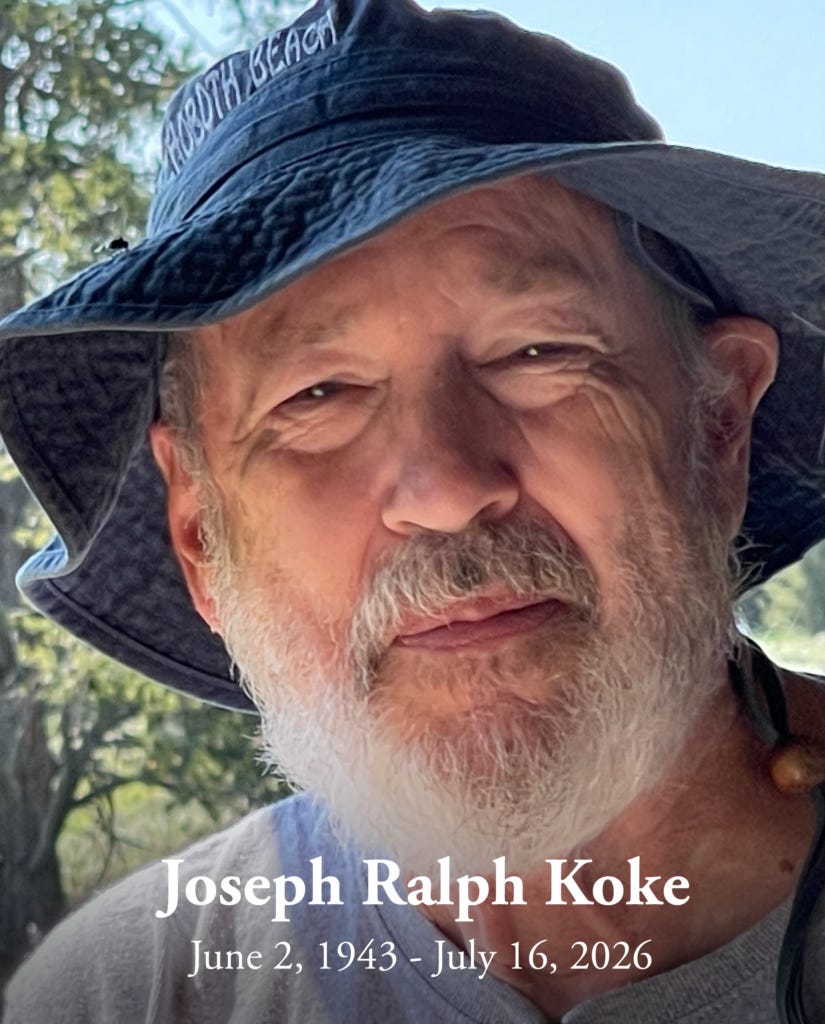
My dad passed away last month (July 16th). He had a profound impact on my life as well as the lives of many others. Read Joseph Koke's obituary here.
On August 15th, at his memorial service, I gave a eulogy.
Eulogy for Joseph Koke
With contributions from Jeff Koke and Jacqueline Clark
Good afternoon…
I am Jak Koke, Joe’s eldest son. Jeff and Jacqueline have asked that I speak on their behalf as well as my own. I’d like to thank everyone for coming. Appreciation also goes to Father Jared for the mass and Zoey for arranging the music.
Before I begin…
…I want to invite everyone to the reception afterwards. Sign the guest book and enjoy food and drink. We’ve done our best to create a nice experience for everyone to share memories of Dad.
I do wonder what Dad would think of it though… He liked to go big on events. He might ask why we didn’t book Linda Ronstadt or The Who. Or why we aren’t doing this at the summit of Mauna Kea, or as some kind of memorial bicycle tour.
To that, I’d say, “Come on, Dad, we’re doing our best. At least we got apple fritters and diet coke.”
As I was working on this eulogy…
…I started thinking of it like a trailer for the movie version of Dad’s life. It’s easy to find dramatic events and even some action scenes. But it’s hard to make a good trailer when everyone knows how the story turns out.
Spoiler alert: The main character dies in the end.
But like all tragedies, it was how the protagonist lived that matters… and the impact Dad had on those of us who knew him: That impact was profound.
When I was 12…
…Dad and I embarked on a journey that would help define my identity. A two-week bicycle tour where we carried everything on the bikes themselves, including tent, sleeping bags, clothes, tools, cooking gear, and food.
About five or six days into the trip, I was getting tired and fatalistic about the whole thing. We’d gone a long way, but this was the hardest thing I’d ever done. Then, late one afternoon, somewhere in Indiana, we hit a rainstorm. So, by the time we found a campground in the dark, everything was wet and we were both starving.
As we set up our camp in the pouring rain, I found myself exhausted and cold and running on fumes. We used our little backpacking propane stove to heat some water and added it to one of the dehydrated food packets – mystery chicken something something. It tasted objectively terrible, and I grew depressed and fatalistic about the trip … I wanted to give up.
We didn’t even split the mystery chicken into our respective mess kits. Dad just added the hot water to the foil bag, waited a few minutes for the dried food block to rehydrate, and we grabbed spoons to start eating. The mystery chicken was very liquidy, like soup almost, and we both ate out of the package at the same time as rainwater dripped off our ponchos into the bag. I was so hungry.
After a few minutes, Dad pulled the bag of soupy slop away and said, deadpan, “Stop eating out of my side of the bag.”
I just stared at him, saying, “What are you talking about? It’s soup; it doesn’t matter which side—” And stopped because he was just grinning at me.
And I laughed. And he laughed. And after that the food didn’t taste so bad, and even though it still rained, I felt better. I felt I could keep going.
And that’s what we did, pedaled on! And even though the trip didn’t get easier, it felt like we’d survived the worse it could throw at us. So, when we encountered the mountains in Pennsylvania, it was just another obstacle—hard, but one I could get through…as long as Dad was with me. We made it all the way to New York, averaging nearly 90 miles a day for the rest of the journey: over 1200 miles in total.
That trip with Dad showed me that I could accomplish really hard things. And that he would support me.
The other thing I learned from him: It’s okay (even as a man) to be silly and vulnerable sometimes.
You see, Dad had a gruff, crusty exterior
He didn’t really do small talk or nod and say socially reassuring things. Dad only ever spoke when he had something relevant or important to say. It made us listen; it gave his words more weight.
But underneath his hard candy shell, he was caring and generous. For people he knew well, he’d joke around, and go out of his way to help, to be supportive, and to mentor and teach.
Dad often invited students along on road trips to see natural wonders and to offer a deeper experience than they could get in the lecture hall and lab. Many became long-lasting friends.
Some of you may remember the graduation parties at our house. Students and friends would gather for barbecue and beer and… of course… Obstacle Course Croquet!
Because for Dad, regular croquet was way too tame. So, he started a tradition of setting up an obstacle course, different every year, with wickets set in weird and super difficult locations—mounted to tree trunks, floating in a kiddie pool, or at the tops of makeshift wooden ramps.
He loved how people reacted to it – at first shocked, then they’d rise to meet the challenge… and laughter and enthusiasm would ensue.
Even as a kid, Dad was mischievous…
…and he never shied away from a shocking demonstration.
One time, he got a hold of some fuses that flashed lights on and off, and decided it would be interesting to see what would happen if he replaced the regular house fuses with them. Then, when all the power in the house started turning off and on – the lights, the TV, the music player – he ran out of the basement declaring the water heater was about to explode. His mother, who had a phobia of exploding water heaters, was not amused.
Another time: As teens, he and his friends Burrle and Tom thought it would be cool to launch a rocket into the sky… so they decided to make their own. Minor problem with that: the fuel they made wasn’t quite the right mix and instead of propelling the rocket, it just exploded… catching the roof of the garage on fire.
This in no way deterred Dad. And years later, when I was around nine or ten, he bought me a model rocket kit. Because, you know, it worked out so well the first time!
Dad didn’t wait for life to happen to him.
He was always learning, seeking new experiences… and he especially loved sharing experiences with other people.
There were family camping trips to places like the Grand Canyon, Zion, the Cascades, the Smithsonian and the Chicago Field Museum. There were the thousands of miles of cross-country bicycle tours with Burrle and Jacqueline and many others.
Also, in our house, listening to new albums was an event. Dad was an audiophile and took pride in his equipment (that he built himself), and he liked to play his music loud. When Pink Floyd’s The Wall first came out, we all gathered in the living room and were blown away as we listened to the entire, double album in one sitting.
When we were young, he read books to us that were full of adventure and intrigue – The Hobbit, Lord of the Rings, Watership Down, Dune. His reading inspired my love of fantasy and science fiction. Even now, when I re-read those books, I hear his voice in my head.
No, Dad wasn’t big on talking about his feelings…
…but he showed his love for us in his actions.
For example, when Jeff started his band Second Glance, Dad let them take over the garage and practice there. Later, after they got good and started playing shows in San Marcos and Austin, he took over running sound. He was hugely supportive of Jeff’s musical ambitions, far beyond merely coming to listen to him play.
Another example: When Jacqueline was 11, she followed Dad to the garage to watch him work on our ailing VW bus engine. He told her, “Don’t just stand there, help! Clean some gaskets.” So what if she was a girl? She could get her hands dirty. And that’s what she did.
And that mindset stuck with her. So that when, some years later, she convinced him to trade in their trustworthy, but boring Chevy S10 for a much cooler T-top Ford Mustang 5-liter GT, he could insist that she help with massive repairs that were needed.
And together they rebuilt the engine and replaced the radiator… and later Jacqueline upgraded the transmission on her own.
Dad helped spark a life-long interest in solving problems…
…sometimes in unconventional ways. He did that for Jacqueline, for Jeff, for me… and for countless students and friends.
Until he couldn’t…
A few years ago, Dad called Jacqueline one afternoon as he was driving home from the store. He couldn’t find his house.
This was a shock; Dad never got lost.
Jacqueline talked him through getting home. Thanks to location tracking on his phone, we knew where he was. When knew that he had actually driven past his driveway twice already without recognizing it. He’d forgotten where he lived.
Several months and a bunch of doctor’s visits later, he was diagnosed with vascular dementia.
Dad always prided himself on his intelligence; his whole identity was tied up in it. In his last few years, his perception of reality, which had been fueled for decades by a sharp and curious mind, became unreliable.
I am saddened to say that Dad’s agency eroded along with his memory and cognition. He lost his ability to drive. He lost the use of his credit cards, which were all maxed out because he would forget things he’d bought and order them several times. He could no longer take care of himself.
The depression and anxiety that came with this disease was orders of magnitude more difficult than what we’d faced in that rainstorm on our bike trip. This was not something that could be cured by a joke.
(I did warn you that this was a tragedy.)
Over the next half-decade, Dad adjusted somewhat to his new situation. His personality changed a little; but if there was a silver lining to that, it’s that the disease seemed to strip away his gruff shell, leaving only his kind-hearted core. And he would, occasionally, still make a wry joke or snarky observation.
It’s in his legacy, however, that we can find joy: his children and grandchildren, the thousands of students, and all the other people he influenced throughout his long life … including every one of you here.
Dad, for all the memorable moments…
…for the life lessons, for your impact on all of us: Thank you.
It has been an overwhelming privilege to be a part of your life, to experience your wit, your generosity, and your love.
We will never forget you.
Joe Koke was a wonderful friend who made a lasting impact on my life and on the lives of my family. Over the more than 30 years I was blessed to know him, I watched him touch hundreds of lives in quiet, remarkable ways.
I first met Joe when I was a fellowship candidate. I had been interviewed by a SWTSU professor, but I was still on the fence about accepting the scholarship. After meeting Joe, however, his passion convinced me to take a chance on something completely outside my comfort zone.
Right out of the gate, it was proposed that we take a “road trip” to kick off my research experience. What? I was in a season of uncertainty in my career. My best friend and mentor had tragically died in a car accident. My principal was pushing me to fill her giant shoes, and up to that point I had mainly been a coach, bus driver, and baby biology/health teacher. Yet there I was, beginning a journey that Joe described as being like drinking water from a fire hydrant with one nostril closed. He wasn’t kidding. The man could describe a situation in fewer words than Webster’s Condensed could ever create.
Once I accepted that challenge, I was never allowed to look back. Joe became my teacher, my biggest supporter, my mentor, my confidant, and one of my dearest friends as he guided me through a fellowship and master’s program. He always wanted to co-author a book and even had a title for it: “Why Johnny Can’t Read in America,” about the failing education system. He saw, long before many others did, how education had been slipping and how public schools were sending less-than-prepared students into his classroom. I always felt Joe was like the canary in the coal mine, because he saw trouble light-years ahead of the professionals in “education.” His foresight drew me in and also encouraged his bride to step into education, because she was so well suited to being a strong role model and teacher with great common sense in the classroom. She did not need traditional teacher education training to be successful, and she certainly excelled in the short time she taught. Joe created a plan to help science teachers pair up with real scientists and paid them real money for their summer work. He changed the lives of those teachers, as well as the students who benefited from their summer experiences. That was Joe’s magic: a gentle push that rippled outward farther than anyone could measure.
This was a recurring theme in Joe’s life. He did not have a storybook childhood, but his mind was never allowed to rest. I think someone in his family should write about his life, because his journey was truly fascinating. Joe was probably the most intelligent person I had ever met, and he was always pushing people to reach higher goals—goals they may or may not have believed were within reach.
Joe never strayed from that path until he was derailed by Judy’s final cancer diagnosis. It nearly broke him, but he stayed faithfully by her side while continuing his work. He kept a journal of their experience, helping all of us make our way through the painful final months of Judy’s life. He helped us while also helping himself endure that heartbreaking season. Afterward, he went quiet for a while, until he found Carolyn. From then on, we stepped back somewhat and kept in touch less as he settled into retirement and his new life.
I will always remember his gentle and kind way of working with students in his lab. They did not always deserve him, but he was deeply nonjudgmental and always believed students would rise to the occasion if given the chance. He did not turn his back on anyone. Although some students did not always appreciate his sense of humor, Joe was honest and upfront with everyone he met. He did not sugarcoat what he had to say; he spoke openly in the lab, never with meanness, but with observations that were sometimes brutally honest and to the point. Bam! You had just been “Koke-ed.”
His road trips were never cut-and-paste experiences. They were adventures—the kind of education one could never fully receive in a classroom or lab. Joe modeled great teaching by giving just enough information, then sending his lab students out to explore questions on their own. He did not hover; he guided. He did not allow less-than-exceptional work to be served up. Instead, he sent people back to redo or rewrite until the work met his standards.
There were so many examples of Joe helping people in extraordinary ways. He could find a solution to almost any problem—whether it meant showing up to help change a flat tire, helping pull a student through emotional difficulty, or stepping in quietly in ways I heard about over the years and again at his memorial. That was who Joe was: a brilliant, kind soul who will be remembered fondly in the lives of hundreds of former students. I hope his brilliance endures in all the lives he touched. I can only imagine that he is now fully blessed with all the answers he ever pondered in the universe.
Lastly, Joe loved his family. He had his “wall of fame” in the lab, filled with some of his favorite students, and adventures but the family pictures in his office were his true pride and joy: his children and grandchildren. He enjoyed a wonderful and fulfilling life, but I think he was happiest watching his children and grandchildren grow into such wonderful, successful human beings. They must know what a great man they had the good fortune to have in their lives. I know I was lucky to have met him, worked with him, and been blessed to call my friend.
Rest well now, Joe, and enjoy your latest adventure. Until we meet again.
T.K.Taylor